
For years, brands treated search visibility as a Google-first game. Rank higher. Get clicks. Bring users to the website. Convert them through content, landing pages, product pages, and offers.
That model still matters, but search behaviour has changed fast.
A buyer today may search on Google, ask ChatGPT for product suggestions, check Perplexity for comparisons, use Gemini for summaries, or rely on AI Overviews before visiting a website. The journey has become wider, faster, and less predictable.
This is where the conversation around SEO vs AEO vs GEO becomes important.
SEO helps a website rank in search engines. AEO helps content appear as a direct answer. GEO helps a brand get cited, mentioned, or recommended inside AI-generated answers.
For marketers, ecommerce brands, SaaS companies, and content teams, this shift matters. Visibility now depends on more than rankings. A brand also needs answer clarity, entity strength, source credibility, structured content, and AI-friendly proof signals.
In simple words, the future of search visibility belongs to brands that can rank, answer, and get cited.
What Is SEO?
SEO, or Search Engine Optimization, is the process of improving a website’s visibility on search engines such as Google and Bing. It focuses on helping web pages rank for relevant search queries.
SEO usually includes keyword research, technical improvements, content optimisation, backlinks, internal linking, page speed, metadata, schema, and user experience.
For example, if a skincare brand wants to rank for “best vitamin C serum for oily skin,” SEO helps the brand create and optimise a page that search engines can understand and rank.
The main goal of SEO is clear: bring users to the website through organic search.
SEO works well when users are actively browsing search results, comparing links, and clicking through to websites. It remains the foundation of digital visibility. However, search journeys now include direct answers and AI-generated recommendations, which is why brands need to understand SEO vs AEO vs GEO more deeply.
What Is AEO?
AEO, or Answer Engine Optimization, focuses on making content clear enough to be selected as a direct answer.
AEO is closely linked to featured snippets, People Also Ask results, voice search, FAQ sections, answer boxes, and short-form search responses. It helps search engines and answer engines pull a specific answer from a page.
For example, if a user searches “How often should I use vitamin C serum?”, AEO helps a skincare brand provide a short, clear, structured answer that can appear directly in search results.
AEO works best when content includes:
- Clear definitions
- Question-led headings
- Short direct answers
- FAQ sections
- Step-by-step explanations
- Schema markup
- Simple and intent-focused language
The key difference between answer engine optimization vs SEO is the outcome. SEO helps a full page rank. AEO helps a specific answer get selected.
This distinction is important. A page can rank well through SEO, while a smaller section of the same page can perform well through AEO. Together, they improve search visibility at different points in the user journey.
What Is GEO?
GEO, or Generative Engine Optimization, focuses on improving brand visibility inside AI-generated answers.
Generative engines such as ChatGPT, Gemini, Perplexity, Claude, and AI Overviews do more than show links. They generate responses, compare options, summarise information, and recommend brands or solutions based on available sources.
GEO helps AI systems understand what a brand does, who it serves, what makes it credible, and why it deserves to appear in a generated answer.
For example, a user may ask:
“Which D2C skincare brands are good for sensitive skin?”
In this case, the brand that appears inside the AI-generated answer gains visibility before the user even visits Google or a website.
That is the core value of GEO. It helps brands earn visibility in AI-led discovery moments.
The difference in generative engine optimization vs SEO comes down to the visibility destination. SEO focuses on rankings. GEO focuses on AI citations, mentions, and recommendations.
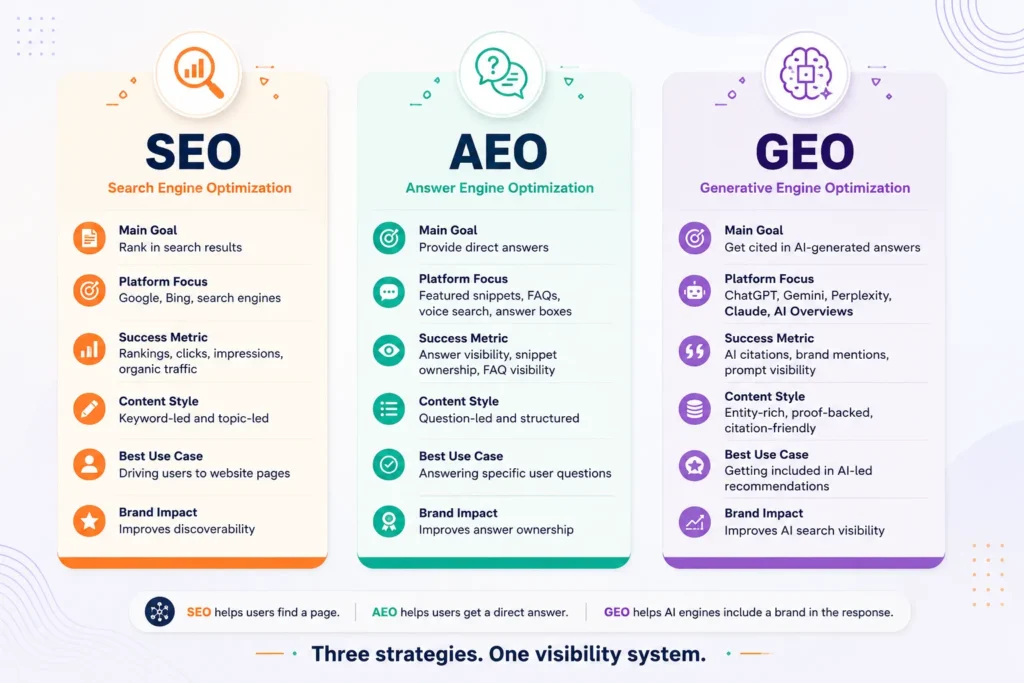
SEO vs AEO vs GEO: The Core Difference
The easiest way to understand SEO vs AEO vs GEO is to look at what each one helps a brand win.
| Area | SEO | AEO | GEO |
|---|---|---|---|
| Full form | Search Engine Optimization | Answer Engine Optimization | Generative Engine Optimization |
| Main goal | Rank in search results | Provide direct answers | Get cited in AI-generated answers |
| Platform focus | Google, Bing, search engines | Featured snippets, FAQs, voice search, answer boxes | ChatGPT, Gemini, Perplexity, Claude, AI Overviews |
| Success metric | Rankings, clicks, impressions, organic traffic | Answer visibility, snippet ownership, FAQ visibility | AI citations, brand mentions, prompt visibility |
| Content style | Keyword-led and topic-led | Question-led and structured | Entity-rich, proof-backed, citation-friendly |
| Best use case | Driving users to website pages | Answering specific user questions | Getting included in AI-led recommendations |
| Brand impact | Improves discoverability | Improves answer ownership | Improves AI search visibility |
In short, SEO helps users find a page. AEO helps users get a direct answer. GEO helps AI engines include a brand in the response.
This is why SEO vs AEO vs GEO should be seen as one connected visibility system instead of three separate marketing trends.
Why SEO Alone Is Becoming Limited
SEO remains important, but it no longer covers the full search journey.
Users now get information through AI summaries, featured snippets, social search, marketplaces, review platforms, comparison websites, and AI assistants. Many discovery journeys happen before a user clicks on a search result.
This creates a new challenge for brands. A website may rank well and still stay absent from AI-generated recommendations.
For example, an ecommerce brand may rank for “best collagen powder,” but if AI tools never mention that brand when users ask for collagen product suggestions, the brand loses visibility in a growing discovery channel.
That is where generative engine optimization vs traditional SEO becomes a practical topic.
Traditional SEO asks, “Can this page rank?”
GEO asks, “Can an AI engine understand, trust, and cite this brand?”
Both questions matter. The difference is that SEO measures visibility on search results pages, while GEO measures visibility inside generated responses.
How AEO Supports Modern Search Visibility
AEO plays an important role between SEO and GEO.
When content is clear, structured, and answer-ready, it becomes easier for search engines and AI systems to interpret. This helps users get quick answers and helps brands build topical clarity.
For example, a nutrition brand can use AEO by answering questions such as:
- What is whey protein?
- How much protein should beginners consume?
- What is the difference between plant protein and whey protein?
- When should protein powder be taken?
Each answer helps search engines understand the brand’s expertise. It also creates useful content blocks that AI systems can read, summarise, and reference.
That is why answer engine optimization vs SEO should not be viewed as a replacement conversation. SEO brings the page into search visibility. AEO makes the answer easier to extract.
When both are strong, GEO has a better foundation.
How GEO Changes Content Strategy
GEO requires brands to think beyond keywords.
AI engines need clarity, consistency, and proof. They look at how a brand is described across its website, product pages, blogs, third-party mentions, reviews, comparison pages, PR content, and trusted external sources.
A GEO-focused content strategy should include:
- Clear brand positioning
- Product and service clarity
- Strong category relevance
- Proof-backed claims
- FAQs and comparison content
- Consistent entity information
- Third-party mentions
- Review signals
- Schema and structured data
- Content that answers real buyer questions
This is where generative engine optimization vs AEO becomes clear. AEO focuses on the answer. GEO focuses on the brand’s chance of being included in AI-generated recommendations.
AEO may help answer “What is sustainable activewear?”
GEO may help a sustainable activewear brand appear when a user asks, “Which activewear brands are good for summer workouts?”
The difference is small on the surface, but huge for brand visibility.
How SEO, AEO, and GEO Work Together
A strong strategy connects all three.
SEO builds the foundation. It helps search engines crawl, index, and rank important pages.
AEO improves clarity. It helps content answer specific questions in a direct and structured way.
GEO adds AI visibility. It helps generative engines understand the brand, trust its content, and include it in relevant answers.
For example, a D2C beauty brand can build one strong content ecosystem by creating:
- SEO-led category pages for high-intent keywords
- AEO-led FAQs for product and ingredient questions
- GEO-led comparison pages, brand proof, reviews, and third-party mentions
This connected approach helps the brand appear across multiple discovery points.
The goal is simple: rank in search, answer user questions, and earn AI citations.
That is the real value of understanding SEO vs AEO vs GEO in 2026.
Why Measurement Changes With GEO
Traditional SEO measurement focuses on rankings, clicks, impressions, traffic, engagement, and conversions.
GEO measurement needs a different lens.
A user may see a brand inside an AI-generated answer and visit the website later through direct search, branded search, social media, or marketplace discovery. That influence may not appear clearly in a standard SEO dashboard.
For GEO, brands need to track:
- AI brand mentions
- Citation frequency
- Prompt visibility
- Competitor appearances
- Accuracy of AI-generated descriptions
- Category-level presence
- Platform-wise visibility across AI tools
- Gaps where the brand should appear but does not
This makes GEO more complex to measure, but also more important.
A brand may have strong organic traffic and still have weak AI visibility. Another brand may appear frequently in AI recommendations even before it dominates search rankings.
This is why SEO vs AEO vs GEO needs to be measured through separate but connected KPIs.
What Brands Should Do Next
Brands should avoid treating SEO, AEO, and GEO as separate teams, separate tasks, or separate content calendars. The better approach is to create one visibility framework that supports all three.
The first step is to strengthen SEO basics. Websites still need crawlable pages, relevant keywords, technical health, internal links, high-quality content, and search-friendly metadata.
The second step is to improve AEO. Content should include direct answers, FAQs, definitions, structured explanations, and schema where useful.
The third step is to build GEO readiness. Brands should strengthen entity signals, improve product or service clarity, earn third-party mentions, maintain consistent messaging, and create proof-backed content that AI engines can trust.
This is especially important for ecommerce, SaaS, B2B services, education, healthcare, finance, and other categories where buyers compare options before speaking to a brand.
In 2026, visibility is no longer only about being found. It is also about being understood, selected, and cited.
Final Thoughts
The search landscape has moved beyond the old ranking-only model.
SEO still matters. AEO adds answer visibility. GEO adds AI-led recommendation visibility. Together, they create a stronger search presence across traditional engines, answer engines, and generative engines.
The brands that understand SEO vs AEO vs GEO early will have a clear advantage. They will create content that ranks, answers, and earns citations across the platforms where users now make decisions.
The future of search visibility belongs to brands that build for humans, search engines, and AI systems at the same time.
FAQ: Clear Answers on SEO vs AEO vs GEO
What is the difference between SEO vs AEO vs GEO?
SEO helps websites rank on search engines. AEO helps content appear as a direct answer through snippets, FAQs, voice search, and answer boxes. GEO helps brands get cited, mentioned, or recommended inside AI-generated answers. The simplest difference is this: SEO wins rankings, AEO wins answers, and GEO wins AI visibility.
Is GEO replacing SEO?
GEO is an added layer over SEO rather than a replacement. SEO still helps websites rank and bring organic traffic. GEO helps brands appear inside AI-generated responses where users ask for recommendations, comparisons, and summaries. A stronger strategy uses SEO, AEO, and GEO together.
What is the difference between answer engine optimization vs SEO?
Answer engine optimization vs SEO differs by outcome. SEO focuses on helping a full page rank in search results. AEO focuses on helping a specific answer get selected for direct responses, snippets, FAQs, and voice search results.
How is generative engine optimization vs SEO different?
Generative engine optimization vs SEO differs in the visibility goal. SEO aims to rank pages in search results. GEO aims to get brands cited or recommended inside AI-generated answers. SEO tracks rankings and clicks, while GEO tracks AI mentions, citations, prompt visibility, and answer accuracy.
How can brands build an SEO, AEO, and GEO strategy?
Brands can begin with strong SEO pages built around search intent. Then they can add AEO elements such as FAQs, direct answers, schema, and question-led headings. For GEO, they should improve entity clarity, third-party proof, review signals, comparison content, and citation-worthy information across trusted sources.
