


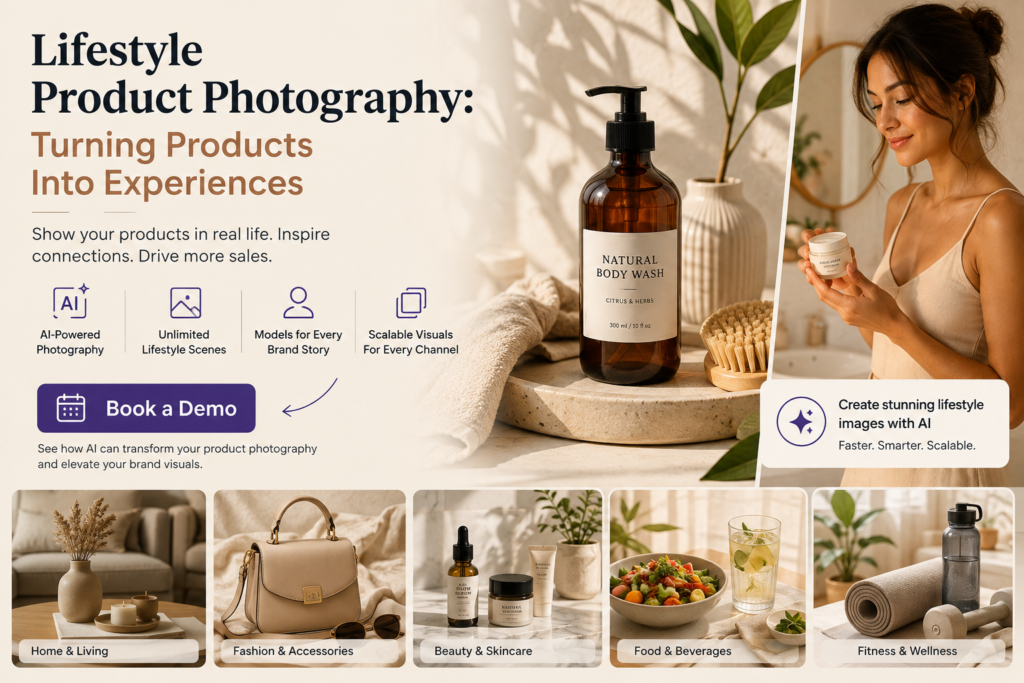
Why Product Images Need More Than Clarity
Most ecommerce brands already have product photos. They have clean pack shots, white-background images, catalog visuals, and close-ups that show shoppers exactly what the product looks like.
But clarity alone does not always create desire.
Lifestyle product photography adds something different: context. It shows how a product fits into a customer’s routine, environment, style, or aspirations. A skincare bottle on a bathroom shelf feels different from the same bottle against a white background. A handbag carried with an outfit tells a different story from a product cutout.
For ecommerce brands, this context can make products easier to understand and easier to imagine owning.
The challenge is that today’s brands need far more than one lifestyle image. Creative teams need visuals for product pages, paid advertising, social media, email campaigns, launches, marketplaces, and seasonal promotions.
AI-powered photography is changing how brands approach that challenge by making it possible to explore more creative directions without treating every new visual as a completely new production project.
What Makes Lifestyle Product Photography Effective
At its simplest, lifestyle product photography places a product in a real or realistic environment.
Instead of showing only the product, it shows the product being used, worn, styled, stored, gifted, consumed, or experienced.
Consider a coffee mug. A standard studio image tells shoppers what the mug looks like. A lifestyle image might show it on a morning desk beside a laptop, with someone reaching for it.
The second image communicates more than appearance. It suggests a moment.
That distinction matters because ecommerce shoppers cannot physically interact with products before purchasing them. They cannot pick up a handbag, try on clothing, test a beauty product, or see how a piece of furniture fits into their home.
Lifestyle imagery helps fill some of that information gap.
Good product lifestyle photos can communicate scale, usage, atmosphere, styling, and emotional appeal while keeping the product at the center of the story.
Turning Products Into Real Customer Moments
The strongest lifestyle visuals are not simply beautiful photographs. They are visual answers to customer questions.
Where would I use this?
What would it look like in my routine?
Who is this product designed for?
How would it fit into my lifestyle?
For fashion brands, lifestyle photography can communicate fit, movement, styling, and personality. Beauty brands can use it to show routines, application, and shelf appeal. Food brands can demonstrate serving occasions and consumption moments. Home brands can use environments to communicate scale and interior styling.
This makes lifestyle photos for products particularly useful when a product’s value depends on how it is experienced rather than simply what it looks like.
The product remains the hero, but the environment gives it meaning.
Models Add Human Context To Products
There are products that become much easier to understand when people are part of the visual.
Lifestyle product photography with models can communicate scale, movement, fit, usage, and emotion in ways product-only images often cannot.
A dress looks more natural when worn. A backpack becomes easier to evaluate when carried. A lipstick becomes more relatable when shown on a face. A wellness product can feel more relevant when integrated into someone’s morning routine.
The model does not necessarily have to dominate the frame.
Sometimes a hand holding a product, a person using it naturally, or a partial lifestyle scene can provide enough human context.
Relatability Can Influence Purchase Confidence
Model-led imagery allows shoppers to imagine themselves using the product.
That is particularly useful for fashion, beauty, accessories, wellness, personal care, and lifestyle brands where identity and emotion are closely connected to purchasing decisions.
However, traditional model photography has an obvious limitation: producing enough variations can become expensive and time-consuming.
Why Traditional Lifestyle Shoots Struggle To Scale
A professional lifestyle product shoot can create high-quality assets, but the production process involves much more than pressing a camera button.
Teams may need to develop concepts, hire photographers and models, arrange locations, source props, coordinate styling, prepare products, manage lighting, review images, handle revisions, and create different formats.
The bigger issue appears after production.
Once a shoot is finished, the brand has a defined set of images. If a campaign later requires another model, location, season, background, mood, or visual angle, the team may need another production cycle.
Ecommerce Creative Demand Never Stops
Paid advertising needs fresh creative.
Social media needs regular content.
Product pages need strong visual storytelling.
Email campaigns need relevant imagery.
New launches require multiple creative directions.
Seasonal promotions need different contexts.
A single photoshoot cannot always satisfy all these requirements.
That is why ecommerce brands are increasingly looking for creative workflows that can generate variations continuously instead of relying only on one-off production cycles.
AI Is Changing The Economics Of Product Photography
AI-powered photography is changing the way ecommerce teams think about visual production.
Instead of physically recreating every environment, brands can use AI-assisted workflows to explore different product scenes, models, backgrounds, campaign concepts, and creative directions.
The biggest advantage is not simply speed.
It is flexibility.
One product can potentially be developed into multiple creative concepts without requiring an entirely new physical shoot for every variation.
For example, a skincare product could be presented in a minimalist bathroom, a travel routine, a premium vanity setting, or a morning self-care scene.
The product remains the same.
The customer context changes.
That allows brands to create visuals around different audiences, occasions, campaigns, and channels.
But there is an important distinction: AI can generate an image quickly, but generating a useful brand asset requires creative direction. See AI-powered photography in action. Book a demo today and discover how your ecommerce brand can create scalable, high-quality product visuals faster.
AI Needs Creative Direction, Not Random Prompts
One of the biggest mistakes ecommerce brands can make with AI photography is treating it as a simple image generator.
A visually attractive image is not automatically a commercially useful image.
It might use the wrong environment. It might appeal to the wrong customer. The styling could conflict with the brand. The product might be positioned incorrectly. Or the image may look impressive but fail to communicate the product’s actual benefit.
Before creating an AI-generated lifestyle image, teams need to understand the purpose behind it.
Who is the audience?
Where will the image appear?
What customer moment should it represent?
What product benefit should stand out?
What visual style should the brand maintain?
AI can accelerate production, but strategy determines relevance.
This is where the concept of an AI Creative Director becomes particularly useful. The reference source describes ShopOS’s Monica as a system designed to bring brand context, audience understanding, campaign direction, models, scenes, and channel requirements into the creative process rather than relying only on isolated image prompts.
Creating More Variants From One Product
For ecommerce brands, the ability to create multiple variations from one product is one of the biggest opportunities AI offers.
A single product can be developed into different creative directions based on the campaign objective.
These can include:
- Different models and customer profiles
- Different environments and use cases
- Different seasonal settings
- Different campaign concepts
- Different formats for ads, product pages, email, and social media
Imagine a backpack brand launching a new product.
The same backpack could appear in a work commute scene, a weekend travel setting, an outdoor environment, or a college lifestyle campaign.
Each visual speaks to a different customer context while keeping the underlying product consistent.
This makes brand lifestyle photography more scalable. Instead of thinking about one perfect image, brands can build a collection of purposeful visuals designed around specific buyer moments.
Brand Consistency Becomes More Important At Scale
More creative does not automatically mean better creative.
As brands increase their visual output, maintaining consistency becomes critical.
A product should still feel like the same product whether it appears in a paid advertisement, product page, Instagram post, email campaign, or seasonal banner.
Lighting, composition, styling, models, environments, colors, and overall visual direction should work together.
This is where AI can either create an advantage or create a problem.
Without brand context, AI may generate visually impressive but inconsistent images.
With a structured creative system, new visuals can be developed around established brand direction.
The source material highlights ShopOS’s Brand Memory as part of this approach, allowing creative work to retain information about brand direction, audience, product story, tone, and previous decisions.
For growing ecommerce teams, this helps turn visual production into a repeatable process rather than a collection of disconnected experiments.
From One Image To A Complete Creative System
The real opportunity is not simply replacing a photoshoot with AI.
It is creating a more flexible creative production system.
An ecommerce brand might start with one product image and develop multiple campaign angles from it.
A fashion brand could create different customer profiles and styling environments.
A beauty brand could explore different routines and settings.
A home brand could visualize the same product across different interiors.
A food brand could show different consumption occasions.
The result is a broader creative library that can support multiple customer touchpoints.
AI makes this process faster, but the strongest results come when AI generation is connected with creative planning, brand context, refinement, and human review.
The reference source describes this workflow through Monica, Spaces, Brand Memory, and Refine, which together are positioned as a connected creative process rather than a standalone image-generation tool.
Better Visuals Can Support Ecommerce Discovery
Lifestyle imagery is not only useful for advertising.
It can also strengthen the overall product experience.
When strong visuals are combined with clear product descriptions, useful FAQs, structured product information, and relevant image alt text, shoppers receive a more complete understanding of the product.
This matters for both traditional search and AI-powered discovery.
Search engines and answer engines increasingly need contextual information to understand products, their uses, audiences, and benefits.
Lifestyle imagery can contribute to that product story when it is aligned with the written content around it.
The objective is not to replace product information with images.
It is to make the product experience more complete.
The Future Of Lifestyle Product Photography
The future of lifestyle product photography is unlikely to be purely traditional or purely AI-generated.
High-end physical shoots will continue to have value for major campaigns, brand films, hero launches, and situations where complete creative control is essential.
At the same time, AI can help ecommerce teams produce the volume and variety of visual content modern marketing requires.
This creates a hybrid model.
Physical photography can establish the core brand and product assets. AI-assisted workflows can then help expand those assets into additional scenes, models, campaigns, and channel-specific variations.
For ecommerce brands, this means creative production can become more responsive to actual marketing needs.
Instead of asking, “What images did we capture?”
Teams can start asking, “What visual does this customer and campaign need?”
Final Thoughts
Lifestyle product photography turns products into experiences by showing shoppers more than what an item looks like. It gives products context, emotion, scale, and a place within everyday life.
For ecommerce brands, that storytelling is becoming increasingly important as customers encounter products across ads, social media, product pages, email, and other digital channels.
AI-powered photography adds another layer to this evolution.
It can help brands explore more models, scenes, campaigns, seasons, and creative directions without treating every new requirement as a completely new photoshoot.
But the real advantage comes from combining AI with creative strategy.
When brand context, audience understanding, campaign objectives, and human review guide the process, AI becomes more than an image generator. It becomes a way to build a scalable visual content system.
For ecommerce brands looking to turn products into experiences at the speed modern marketing demands, that shift could become a significant creative advantage.
FAQs
1. What is lifestyle product photography?
Lifestyle product photography presents a product in a realistic environment, use case, or customer situation. It helps shoppers understand how the product could fit into their everyday lives.
2. How can AI improve lifestyle product photography?
AI can help ecommerce brands create more product scenes, model variations, campaign concepts, seasonal visuals, and channel-specific creative assets without requiring a new physical photoshoot for every variation.
3. Is lifestyle product photography with models useful for ecommerce?
Yes. Model-led visuals can help communicate product scale, fit, movement, usage, and emotion. They can also make it easier for shoppers to imagine themselves using the product.
4. Can AI replace traditional product photoshoots?
AI can reduce the need for some types of repeat lifestyle production, but traditional photography remains valuable for original brand assets, major campaigns, and situations requiring precise physical control. A hybrid approach can offer both authenticity and scalability.
5. How many lifestyle photos should an ecommerce brand create?
There is no fixed number. The right volume depends on the products, audiences, channels, campaigns, and seasonal requirements. Brands typically benefit from having different visuals for product pages, advertising, social media, email, launches, and retargeting.