


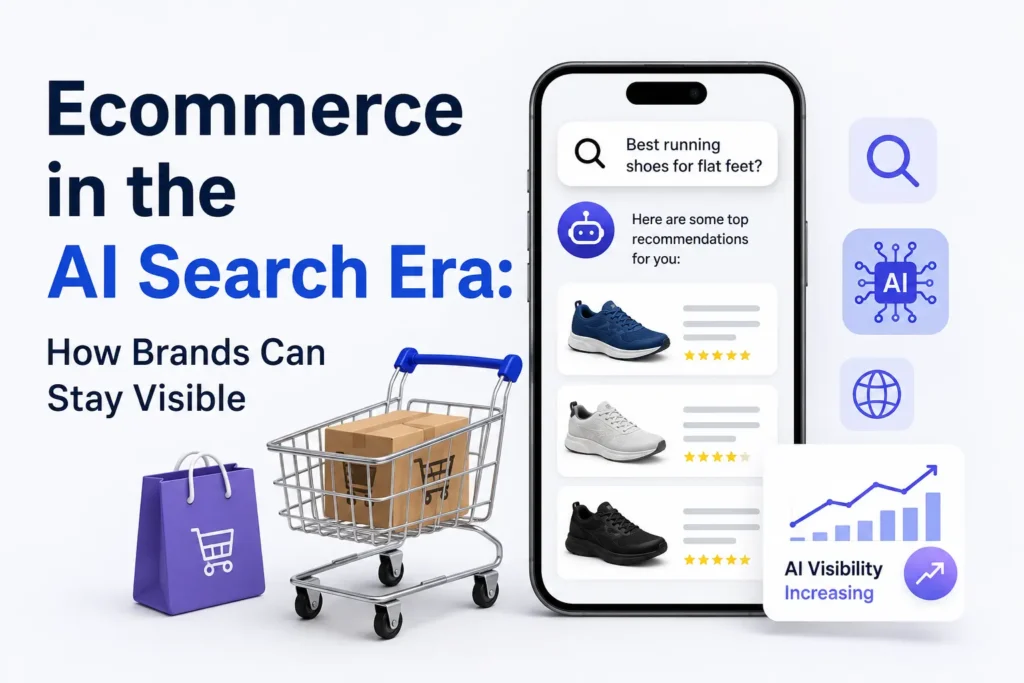
AI Search Is Changing Ecommerce Discovery
An AI visibility tool is becoming an important part of ecommerce marketing as customers increasingly use AI platforms to research, compare, and discover products. Instead of typing a short keyword into a search engine and browsing several pages, shoppers can now ask detailed questions and receive direct recommendations.
For ecommerce brands, this changes the visibility equation.
Ranking on traditional search results is still valuable, but it no longer tells the whole story. A brand may have strong organic rankings while competitors are being recommended more frequently inside AI-generated answers.
This creates a new challenge for marketing teams: understanding where their products appear in AI search, where competitors are gaining attention, and what can be done to improve visibility.
Why AI Visibility Tool Adoption Is Growing
The rise of conversational search has created a new layer of product discovery. Customers can ask questions based on specific requirements, budgets, preferences, use cases, and personal circumstances.
For example, instead of searching for “running shoes,” a customer might ask, “What are the best running shoes for beginners with flat feet under ₹8,000?”
An AI assistant can interpret the context and recommend products that appear relevant.
An AI visibility tool helps ecommerce teams understand whether their brand is included in these recommendations. It can reveal which prompts produce brand mentions, which products are being discussed, and which competitors are appearing more consistently.
This insight gives marketers a clearer view of visibility beyond conventional keyword rankings.
Traditional Search Metrics Leave Important Gaps
SEO teams have spent years monitoring rankings, impressions, clicks, organic traffic, backlinks, and conversions. These metrics remain important, but AI-generated search introduces a different type of result.
There may not be a traditional ranking position when an AI assistant produces a conversational answer. Several brands can be recommended within the same response, and the explanation around each recommendation can influence how customers perceive them.
The Problem With Rankings Alone
Consider an ecommerce electronics brand that ranks well for “wireless headphones.”
Its website receives organic traffic, but when shoppers ask AI platforms for “best wireless headphones for frequent travellers,” three competitors may consistently appear while the brand is missing.
Traditional SEO reporting might not immediately identify this problem.
An AI visibility tool can expose that gap by tracking relevant customer prompts and showing where the brand appears or disappears.
That makes visibility measurement more closely connected to how customers are actually researching products.
AI Search Visibility Influences Brand Consideration
AI Search Visibility is not simply about getting a company name mentioned.
The context of the mention matters.
A brand appearing in a generic informational answer has a different commercial value from a product being recommended during a comparison between competing options.
For ecommerce businesses, high-intent prompts deserve particular attention. These include questions about the best products, alternatives, pricing, product suitability, comparisons, features, and specific customer requirements.
If a competitor repeatedly appears for these queries, it may be influencing the customer before the customer reaches a product page.
This is why AI visibility tracking should focus on commercially relevant prompts rather than collecting as many brand mentions as possible.
Competitor Tracking Reveals New Opportunities
One of the strongest applications of an AI visibility tool is competitor analysis.
Imagine a skincare brand discovers that competitors frequently appear for questions related to sensitive skin, fragrance-free products, and lightweight moisturizers. The brand has relevant products but receives far fewer recommendations.
That creates an opportunity to investigate.
The marketing team can examine how competitor products are described, what information is available about them, which third-party sources mention them, and how clearly their product benefits are communicated.
The objective is not to copy competitors. It is to understand why their products are easier to discover and evaluate in AI-generated answers.
This makes AI search data useful for both competitive intelligence and strategic planning.
LLM Visibility Tools Provide Deeper Context
Not every AI tracking solution is designed for ecommerce.
Some LLM monitoring tools focus primarily on the technical performance of AI applications. They may measure response quality, latency, errors, token usage, or model performance.
Those capabilities are valuable for technical teams building AI products.
Ecommerce marketers have a different set of priorities.
They need to know whether their products are being recommended, which competitors appear alongside them, what prompts trigger those recommendations, and which sources influence the answers.
This is where LLM visibility tools can provide a more marketing-focused perspective.
Instead of simply asking whether an AI model is functioning correctly, marketers can ask whether their brand is visible when customers are making purchase-related decisions.
Product Content Can Shape AI Discovery
AI search visibility is closely connected to the quality and clarity of product information.
An ecommerce website may sell an excellent product, but if its product page contains a generic description, incomplete specifications, or limited information about use cases, customers and AI systems may have less context to understand its relevance.
For example, a running shoe page could simply say that the product is “comfortable and lightweight.”
A stronger product page might clearly explain its cushioning, intended running surface, weight, fit, support level, weather suitability, and ideal customer profile.
The second version provides significantly more useful context.
An AI monitoring tool can help identify products or categories where visibility is weaker, giving marketing teams a starting point for improving product information.
Third-Party Sources Matter For AI Visibility
A brand’s website is not necessarily the only source influencing AI-generated recommendations.
Product reviews, comparison websites, editorial publications, marketplaces, industry resources, and other credible sources can contribute to the information available about a brand.
This makes source and citation analysis an important part of AI visibility strategy.
Suppose Brand A has strong product pages but limited third-party coverage, while Brand B is regularly discussed by trusted publications and comparison sites.
Even if both brands sell similar products, Brand B may have a stronger digital information footprint.
For ecommerce marketers, this insight can influence content strategy, digital PR, partnerships, product reviews, and broader authority-building efforts.
AI Visibility Tracking Should Support SEO
AI search does not mean traditional SEO is disappearing.
In fact, the two approaches can work together.
SEO helps brands understand how their websites perform in traditional search environments. AI visibility tracking adds another layer by showing how those brands and products appear within conversational AI experiences.
A modern ecommerce strategy can therefore use both.
Search rankings can identify opportunities in traditional organic search, while AI visibility data can reveal where products are being recommended—or overlooked—in AI-generated responses.
The combination gives marketing teams a broader understanding of digital discovery.
Turning AI Visibility Data Into Action
Measurement alone does not create business value.
The real advantage comes from turning visibility insights into practical decisions.
A useful process begins by identifying important customer prompts. Brands can then monitor their visibility, compare competitor performance, investigate citation sources, and identify gaps.
From there, teams can prioritize improvements instead of making changes based on assumptions.
For example, if a brand consistently disappears from prompts involving a particular product attribute, marketers can review whether that attribute is clearly communicated across product pages and supporting content.
Over time, teams can measure whether those changes improve visibility.
This turns an AI visibility tool from another reporting platform into a practical decision-making resource.
Building A More Resilient Ecommerce Strategy
AI search is still evolving, which means ecommerce brands should avoid treating visibility as a one-time project.
Customer prompts change. New competitors emerge. Product information evolves. AI platforms change how they generate and present responses.
Continuous AI visibility tracking allows marketing teams to monitor these changes instead of relying on an outdated snapshot.
The goal is not to optimize for every possible AI query.
It is to identify the questions that matter most to customers and make sure the brand has a credible opportunity to be discovered when those questions are asked.
This requires coordination between SEO, content, ecommerce, product, analytics, and marketing teams.
Final Thoughts
Ecommerce discovery is moving into a more conversational and recommendation-driven environment. An AI visibility tool gives brands a practical way to understand this change and measure how they appear across AI-powered search experiences.
Traditional SEO remains essential, but it cannot fully answer whether customers are seeing your products when they ask AI platforms for recommendations.
With AI visibility tracking, ecommerce teams can identify competitor gaps, monitor product recommendations, understand important prompts, evaluate information sources, and prioritize improvements.
The brands that adapt early can build a stronger understanding of how customers discover products in the AI search era.
The question is no longer simply whether your website ranks.
It is whether your AI Search Visibility is strong enough to keep your brand in the conversation when customers are ready to buy.
Book a demo today to discover how AI visibility tracking can help your ecommerce brand monitor competitors, identify visibility gaps, and make smarter marketing decisions.
FAQs
1. What is an AI visibility tool?
An AI visibility tool helps ecommerce brands monitor how their products and brand appear in AI-generated answers. It can track relevant prompts, competitor recommendations, brand mentions, and other visibility signals across AI search experiences. Platforms like ShopOS help businesses make faster, data-driven marketing decisions.
2. Why does AI Search Visibility matter for ecommerce?
AI platforms are becoming part of product research and comparison journeys. If competing products are repeatedly recommended while your products are absent, competitors may influence customers before they ever visit your website.
3. Are LLM monitoring tools the same as LLM visibility tools?
Not necessarily. Many LLM monitoring tools focus on technical AI application performance, while LLM visibility tools are designed to understand how brands, products, and competitors appear within AI-generated responses.
4. How can AI visibility tracking support SEO?
AI visibility tracking complements traditional SEO by measuring visibility in AI-generated answers. SEO can continue monitoring rankings and organic traffic while AI visibility data provides insight into conversational product discovery.
5. What should ecommerce brands monitor in AI search?
Brands should monitor high-intent customer prompts, product recommendations, competitor mentions, citation sources, and changes in visibility over time. These metrics can help marketing teams identify where improvements are needed.