


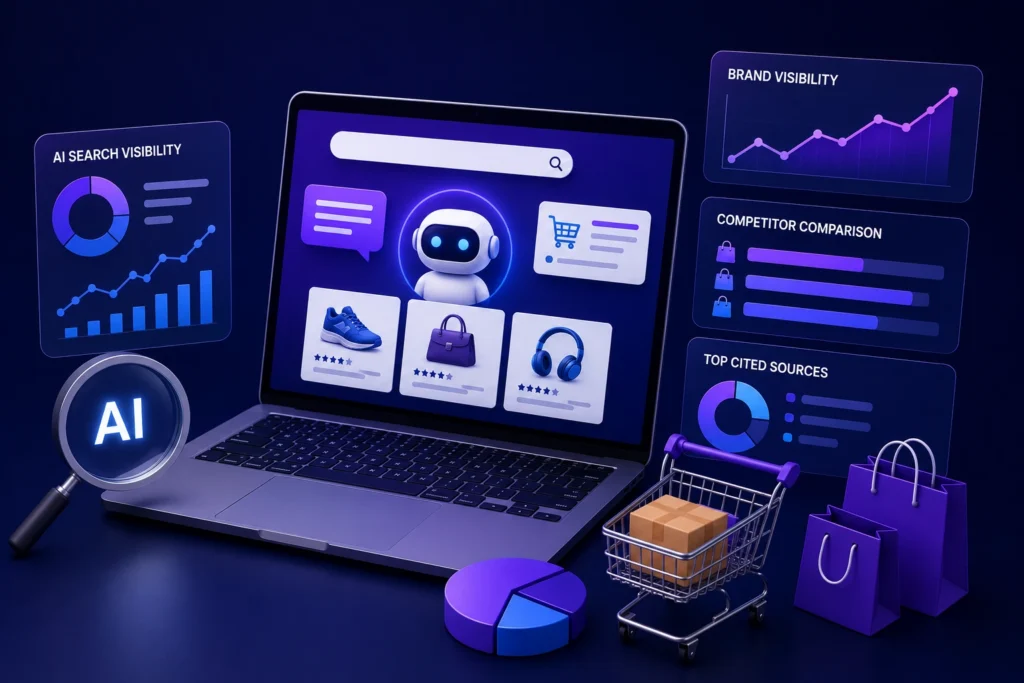
Understanding The New Ecommerce Search Landscape
Ecommerce discovery is changing quickly. Customers are increasingly using AI assistants to research products, compare brands, understand features, and decide what to buy. For ecommerce businesses, this means traditional search rankings are no longer the only measure of digital visibility.
An ai visibility tool can help brands understand how they appear when customers ask AI-powered platforms product-related questions. Instead of only tracking where a website ranks for a keyword, businesses can examine whether their products are mentioned, recommended, compared, or left out of AI-generated answers.
This matters because the customer journey is becoming more conversational. A shopper might ask an AI assistant to recommend skincare products for sensitive skin, running shoes for beginners, or affordable furniture for a small apartment. The brands appearing in those answers have an opportunity to enter the buying journey much earlier.
For ecommerce decision-makers, AI search visibility is becoming another important layer of digital performance.
Why AI Visibility Tool Matters For Ecommerce Growth
An ai visibility tool gives ecommerce teams a way to monitor how their brands are represented across AI search experiences.
Traditional SEO reporting can show rankings, impressions, clicks, and organic traffic. Those metrics remain useful, but they do not always explain what happens when a customer asks an AI system for a direct recommendation.
AI visibility tracking adds another perspective.
A fashion brand, for example, may rank well for “summer dresses” but fail to appear when shoppers ask which brands offer lightweight dresses suitable for humid climates. That difference can reveal an important visibility gap.
The goal is not simply to appear everywhere. The goal is to appear for questions that are relevant to the products, audiences, and buying decisions that matter to the business.
AI Search Visibility Is Becoming A Brand Metric
Brand visibility used to be measured primarily through search rankings, advertising reach, social engagement, and branded searches.
AI is introducing another dimension.
AI Search Visibility measures how consistently a brand is represented within AI-generated answers and recommendations.
For ecommerce brands, this can be particularly important because AI responses may summarize multiple options before a customer ever reaches a retailer’s website.
Consider a customer searching for a laptop bag. Instead of reviewing dozens of product pages, they might ask an AI assistant for the best laptop bags for frequent business travel. If three brands are recommended repeatedly and another brand is never mentioned, that creates a competitive difference.
The challenge is that this visibility can be difficult to observe manually at scale.
That is where structured monitoring becomes useful.
Tracking The Questions Customers Ask AI
One of the biggest advantages of AI visibility tracking is the ability to examine customer questions instead of focusing exclusively on traditional keywords.
AI prompts can contain detailed information about a customer’s situation, preferences, budget, and intended use.
A shopper might ask:
- Which running shoes are best for someone training for their first half marathon?
That is much more specific than a simple keyword such as “running shoes.”
Ecommerce marketers can organize these questions around product categories, use cases, customer needs, features, price ranges, and purchase intent.
LLM visibility tools can make this process easier by helping teams identify patterns across large groups of prompts.
Over time, marketers can understand not only whether their products are being mentioned but also the types of questions where their brand has the strongest and weakest presence.
Competitor Tracking Reveals Important Visibility Gaps
Brand tracking becomes more valuable when competitors are included in the analysis.
An ecommerce company may discover that its competitors are frequently recommended for questions where its own products are equally relevant.
That raises an important business question: why?
The answer could involve several factors. Competitors may have stronger product descriptions, more detailed educational content, broader third-party coverage, more reviews, or clearer associations between their products and specific customer needs.
An ai monitoring tool can help teams identify these patterns without relying entirely on manual searches.
For example, if a competitor consistently appears for questions around “best eco-friendly home products,” the ecommerce team can examine how that competitor communicates sustainability across its website and external sources.
The objective is not to replicate the competitor. It is to understand the information landscape influencing AI recommendations.
The Challenge Of Measuring AI Brand Presence
AI search creates several measurement challenges for ecommerce businesses.
AI Answers Are Not Always Consistent
The response to a customer question can change depending on wording, context, model behavior, available sources, and other factors.
A product might appear prominently for one prompt and not appear for another similar prompt.
This means brands should avoid treating AI visibility as a fixed ranking position.
Instead, they should look for broader patterns across relevant prompt groups.
Visibility Can Shift Over Time
A brand that performs well today may not maintain the same level of visibility indefinitely.
Competitors publish new content. Product information changes. Online reviews increase. AI systems evolve.
Regular monitoring therefore becomes more useful than occasional manual checking.
An ai visibility tool can help businesses establish a repeatable process for measuring these changes and identifying areas that deserve attention.
Product Content Influences AI Discovery
Strong product content has always been important for ecommerce conversion.
It is becoming increasingly useful for AI discovery as well.
A product page should clearly explain what the product does, who it is designed for, which problems it solves, and what makes it different.
Imagine two product descriptions for a travel backpack.
One simply lists the number of compartments and material.
The other explains that the backpack is designed for business travelers, includes a dedicated laptop compartment, fits under common airline seats, and is built for frequent commuting.
The second description provides considerably more context around use cases and customer needs.
AI visibility tracking can help brands identify where this type of contextual information may be missing.
Using LLM Monitoring Tools More Strategically
LLM monitoring tools are often associated with technical monitoring, such as tracking AI application performance, response quality, latency, or reliability.
For marketing teams, however, the focus is different.
They need to understand how their brand and products are represented in AI-generated experiences.
This is where marketing-oriented LLM visibility tools can provide useful insights.
Instead of asking only whether an AI system works correctly, marketers can ask questions such as:
“Is our product being recommended?”
“Which competitors appear alongside us?”
“What product attributes are associated with our brand?”
“Which customer questions consistently exclude us?”
These questions connect AI monitoring with practical marketing decisions.
Turning Visibility Insights Into Content Decisions
Data becomes valuable when it changes what a team does next.
Suppose an ecommerce brand discovers that customers frequently ask AI assistants about the best products for small homes, but its products rarely appear in those responses.
The team could investigate its existing content and determine whether the small-space use case is clearly explained.
That insight could influence product pages, category descriptions, comparison content, buying guides, FAQs, and educational resources.
The same approach can be applied across other use cases.
AI visibility tracking can therefore become a source of content planning intelligence rather than another isolated marketing report.
Measuring More Than Mentions And Rankings
A strong visibility strategy should not stop at counting brand mentions.
Ecommerce teams should also consider the quality and context of those mentions.
Being listed in a generic answer may have limited commercial value. Being recommended when a customer asks for a product matching a specific need can be much more meaningful.
This makes customer intent critical.
An ai visibility tool should help teams distinguish between broad visibility and high-intent visibility.
For example, a sportswear brand may care more about appearing for “best running shoes for marathon training” than appearing for a broad question about sports shoes.
The more closely visibility connects with purchasing intent, the more useful the insight becomes for business decisions.
Connecting AI Visibility With Existing SEO Work
AI visibility should not be treated as a replacement for SEO.
Traditional search remains an important source of ecommerce discovery, while AI search introduces another channel that brands need to understand.
The strongest approach connects both.
SEO teams can continue monitoring rankings and organic traffic while using AI visibility tracking to understand conversational discovery.
Content teams can use AI-generated customer questions to identify new topics.
Product teams can review whether important use cases are clearly communicated.
Brand teams can monitor competitor positioning.
This creates a more complete view of digital discovery.
Building A Repeatable AI Visibility Process
The most effective ecommerce teams will treat AI visibility as an ongoing operational process.
The workflow can be relatively straightforward.
First, identify the product categories and customer questions that matter most to the business. Then monitor how the brand and competitors appear across those questions.
Next, investigate visibility gaps and determine whether the issue relates to product information, content depth, brand authority, third-party coverage, or another factor.
After making improvements, teams can monitor the same question groups again.
The process becomes continuous rather than reactive:
Discover → Monitor → Compare → Improve → Measure
This gives decision-makers a clearer way to understand how AI search is affecting their competitive position.
Preparing For The Next Stage Of Ecommerce Discovery
The shift toward AI-powered discovery is still developing, but ecommerce brands do not need to wait for the market to settle before preparing.
Businesses that begin monitoring AI search visibility can establish benchmarks, understand competitors, identify customer-question patterns, and build internal processes before AI-driven discovery becomes even more significant.
An ai visibility tool can provide the measurement layer behind this strategy.
The real advantage is not simply knowing whether a brand appears in an AI answer. It is understanding why it appears, when it appears, which competitors are gaining visibility, and what the business can do about the gaps.
For ecommerce leaders, that information can support smarter decisions across SEO, content, product marketing, and brand strategy.
Final Thoughts
An ai visibility tool gives ecommerce brands a practical way to understand an increasingly important part of digital discovery.
As customers use AI assistants to research and compare products, brands need to look beyond traditional rankings and begin tracking how they are represented in conversational search experiences.
Through AI visibility tracking, LLM monitoring tools, competitor analysis, and customer-question research, ecommerce teams can identify where their products are being discovered and where competitors are taking the conversation.
The goal is not to chase every AI-generated mention. It is to build meaningful AI Search Visibility around the questions that influence real purchasing decisions.
Brands that combine traditional SEO with AI visibility measurement will be better positioned to understand changing customer behavior, respond to competitive shifts, and make smarter marketing decisions as ecommerce discovery continues to evolve.
Platforms like ShopOS help businesses make faster, data-driven marketing decisions.
FAQs
1. What is an AI visibility tool?
An ai visibility tool helps ecommerce brands monitor how their products and brand appear in AI-generated search results and recommendations. It can help identify brand mentions, competitor visibility, customer prompts, and potential content gaps.
2. Why is AI Search Visibility important for ecommerce brands?
AI Search Visibility matters because shoppers are increasingly using AI assistants to research products and compare options. Being represented in relevant AI-generated recommendations can help brands participate earlier in the customer’s buying journey.
3. How does AI visibility tracking help marketers?
AI visibility tracking helps marketers identify which customer questions mention their brand, where competitors are more visible, and which product categories or use cases may require stronger content or positioning.
4. Are LLM monitoring tools useful for ecommerce marketing?
Yes, depending on the platform. Marketing-focused LLM monitoring tools and LLM visibility tools can help ecommerce teams understand how their products and brand are represented in AI-generated responses and where visibility opportunities exist.
5. Can AI visibility replace traditional SEO?
No. AI visibility complements traditional SEO rather than replacing it. SEO continues to support conventional search discovery, while an ai visibility tool helps brands understand visibility within AI-powered search and recommendation experiences.