


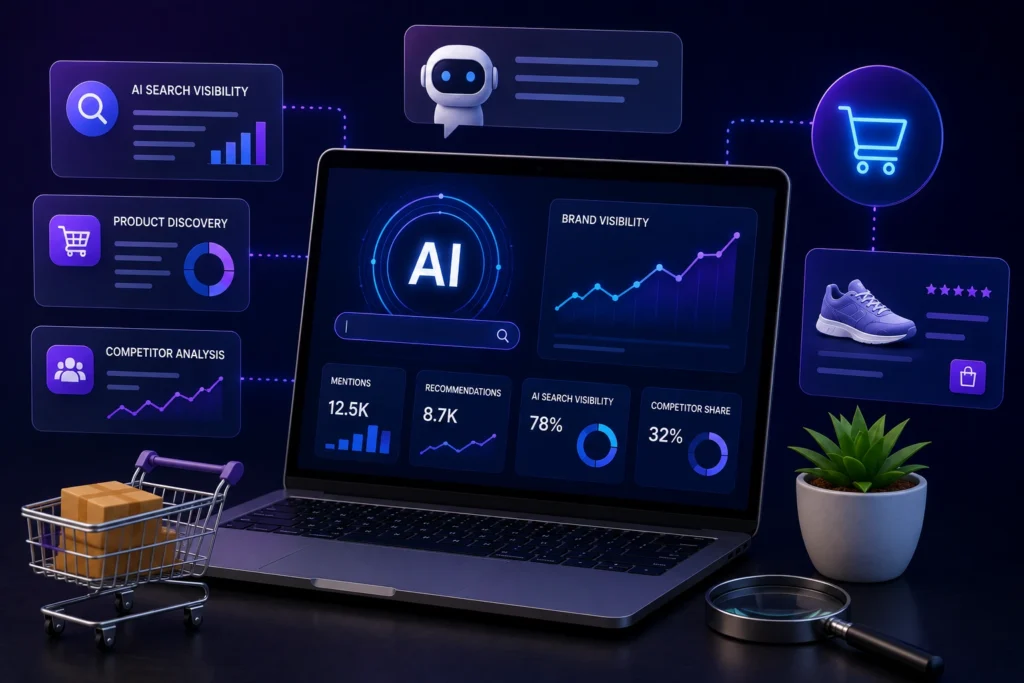
AI Search Is Changing How Ecommerce Brands Compete
An AI visibility tool is becoming increasingly important for ecommerce brands as customers change how they discover products online. Shoppers are no longer relying exclusively on traditional search engines. They are asking AI assistants for product recommendations, comparisons, buying advice, alternatives, and solutions tailored to specific needs.
That shift creates a new competitive challenge. A brand can have strong organic rankings, quality products, and an established website but still be missing from AI-generated recommendations. Meanwhile, competitors may be appearing repeatedly in the answers that influence customers before they ever visit a store.
For ecommerce decision-makers, this means visibility now needs to be measured across more than conventional search results. Brands need to understand how they are represented in AI-powered discovery and where competitors are gaining an advantage.
AI Visibility Tool Gives Brands A Competitive View
An AI visibility tool helps ecommerce teams understand how their products and brand appear across AI-generated search experiences.
Instead of looking at a single visibility score, marketers can investigate specific buyer questions and discover whether their brand is mentioned, recommended, compared, or completely absent.
For example, a footwear company might want to know whether its products appear when customers ask:
“Which running shoes are best for long-distance beginners?”
“Which lightweight shoes are good for travel?”
“What are the best running shoes for people with wide feet?”
These are commercially meaningful questions because they reflect real product-selection situations.
AI visibility tracking can help brands monitor these queries consistently and compare their presence against competing products.
This creates a clearer picture of where the brand is winning attention and where it is being overlooked.
Why Traditional Rankings No Longer Tell Everything
Search rankings remain valuable, but they do not provide the complete picture of modern product discovery.
A brand might rank on the first page for an important keyword but still fail to appear when an AI assistant provides a detailed recommendation.
The reason is simple: traditional search and AI-generated answers work differently.
Search engines generally present a collection of results for users to evaluate. AI systems can synthesize information and provide a more direct recommendation or comparison.
This changes the competitive dynamic.
When an AI assistant recommends three products, customers may focus heavily on those three options instead of reviewing dozens of traditional search results.
That makes AI Search Visibility an increasingly important consideration for ecommerce marketing teams.
Understanding What Customers Ask AI Assistants
One of the strongest uses of AI visibility tracking is understanding the questions customers are actually asking.
These questions can be much more detailed than conventional keywords.
A customer may not search for “office chair.” They might ask an AI assistant to recommend an ergonomic office chair for someone working eight hours a day with lower-back support and a specific budget.
That prompt contains multiple buying signals.
An ecommerce brand can use these questions to understand how customers describe their needs and whether its product information addresses those needs clearly.
LLM visibility tools can help organize these queries into themes such as product comparisons, use cases, price considerations, features, customer types, and purchase intent.
This turns AI search monitoring into a source of customer insight rather than just a reporting exercise.
Competitor Visibility Reveals Missed Opportunities
Knowing where your brand appears is useful.
Knowing where competitors appear instead can be even more valuable.
Suppose a home fitness brand discovers that competitors are frequently recommended for questions related to compact exercise equipment for apartments. The brand sells suitable products but rarely appears in those answers.
That gap deserves investigation.
The problem may not necessarily be the product itself. Competitors may have clearer product descriptions, stronger category content, more detailed buying guides, or greater third-party coverage.
An AI monitoring tool can help marketers identify these competitive patterns and prioritize areas for deeper analysis.
The objective is not to copy competitors.
It is to understand why their products are easier for AI systems to associate with specific customer needs.
The Challenge Of Measuring AI Visibility
AI search introduces a measurement challenge that many ecommerce teams have not faced before.
Visibility Can Change With The Question
A product may appear prominently for one prompt but disappear for another closely related question.
For example, a skincare brand might be recommended for “best moisturizer for dry skin” but not for “best moisturizer for sensitive dry skin.”
That difference matters.
It suggests that visibility is not simply about whether a brand is known. It is also about how effectively the brand’s products are associated with specific customer requirements.
AI Answers Can Change Over Time
AI-generated responses can also evolve as models, sources, product information, and online content change.
This makes one-time analysis insufficient.
Brands need ongoing AI visibility tracking to understand whether their presence is improving, declining, or shifting toward different product categories and customer questions.
Product Content Has A Bigger Role To Play
Product pages are often treated primarily as conversion assets.
In the AI search environment, they can also help communicate what a product is, who it is for, what problem it solves, and how it compares with alternatives.
Consider a premium backpack.
A basic description might say that it has multiple compartments, padded straps, and water-resistant material.
A stronger product explanation could clarify that it is designed for daily commuting, protects laptops up to a particular size, and provides weather protection for urban travel.
The second version provides much stronger contextual information.
An AI visibility tool can help brands identify product-related questions where their existing information may not sufficiently explain these use cases.
Citations Show Where AI Gets Its Information
Brand visibility is only one part of the picture.
Ecommerce teams should also understand where AI-generated answers obtain supporting information.
AI responses can draw on brand websites, retailers, publishers, reviews, comparison pages, industry resources, and other online sources.
This makes citation analysis useful.
Suppose a competitor is consistently recommended for a product category and several responses reference reputable product reviews. That may indicate that the competitor has stronger third-party visibility around particular product attributes.
The brand can then investigate those sources and understand what information is being reinforced across the wider ecosystem.
This is where LLM monitoring tools and marketing-focused LLM visibility tools should be clearly distinguished. Technical monitoring platforms may focus on AI application performance, while marketing-focused tools examine brand presence and product recommendations.
Turning AI Visibility Data Into Action
Measurement only becomes valuable when it leads to decisions.
Ecommerce teams can use AI visibility tracking to prioritize improvements across product content, category pages, comparison content, FAQs, buying guides, and external brand coverage.
A practical process might begin by identifying high-intent prompts where competitors consistently appear.
The team can then examine the reasons behind those recommendations, compare the information available about competing products, and identify areas where its own content could provide clearer answers.
After improvements are implemented, the same prompt groups can be monitored again.
This creates a continuous process:
Measure → Compare → Diagnose → Improve → Monitor
The advantage is that marketing teams are no longer optimizing blindly. They can connect content and brand improvements to specific visibility gaps.
AI Visibility Supports Smarter Content Planning
Content teams often face the same challenge: deciding what to create next.
Keyword volume provides one source of information, but AI-generated product questions provide another.
If customers repeatedly ask detailed questions about a particular product feature, that can become a useful content opportunity.
For example, an outdoor brand may discover that customers frequently ask AI assistants about the best waterproof jackets for humid climates.
That insight could influence product descriptions, buying guides, comparison pages, and educational content.
The content strategy becomes more closely connected to customer decision-making.
Instead of producing content simply because a keyword appears popular, teams can create resources around questions that influence actual product consideration.
Measuring Business Impact Beyond Visibility Scores
Visibility itself is not the final business objective.
Ecommerce leaders ultimately want stronger discovery, consideration, conversions, and revenue.
An AI visibility tool should therefore support broader marketing analysis rather than becoming another isolated dashboard.
Teams can monitor whether improvements in AI visibility coincide with increased referral traffic, branded searches, product engagement, or sales.
It is also important to distinguish between high-volume visibility and high-value visibility.
Being mentioned for a broad informational question may have limited commercial value. Appearing consistently when customers ask for specific product recommendations may be far more meaningful.
This makes intent an important part of AI visibility measurement.
Building AI Visibility Into Marketing Operations
AI search monitoring should not become a task that someone checks once every few months.
It works better when incorporated into existing marketing operations.
SEO teams can use it alongside traditional search analysis. Content teams can use prompt insights to identify new topics. Ecommerce teams can investigate product visibility. Brand teams can monitor competitor positioning.
Over time, these teams can build a shared understanding of how customers discover products through AI.
That creates a more connected approach to digital visibility.
Instead of treating AI search as another isolated channel, brands can make it part of their broader customer-discovery strategy.
Staying Competitive As AI Search Evolves
The biggest opportunity for ecommerce brands is not simply appearing in more AI answers.
It is becoming more relevant to the questions that matter most to their customers.
That requires clear product information, useful content, credible external sources, strong brand positioning, and continuous measurement.
An AI visibility tool provides the measurement layer needed to understand whether those efforts are working.
As AI-powered discovery continues to develop, the brands that monitor their presence early will have more information to guide their decisions.
They will know which questions they are winning, where competitors are stronger, and which opportunities deserve attention.
Final Thoughts
An AI visibility tool gives ecommerce brands a practical way to understand how their products and brand are represented in AI-powered discovery.
Traditional rankings remain important, but they are no longer the only way customers find and evaluate products. AI visibility tracking provides another layer of insight by showing how brands appear in recommendations, comparisons, and conversational product searches.
For ecommerce leaders, the goal should not be chasing every AI-generated mention. It should be building meaningful visibility around the questions that influence purchasing decisions.
By combining AI Search Visibility insights with strong product content, traditional SEO, competitive research, and ongoing measurement, ecommerce brands can build a more resilient approach to digital discovery.
The brands that start measuring this shift now will be better prepared to compete as AI becomes a larger part of how customers research what to buy.
Book a demo today to discover how AI-powered campaign intelligence can help your ecommerce advertising team analyze performance, identify opportunities, and make smarter growth decisions.
FAQs
1. What is an AI visibility tool?
An AI visibility tool helps brands monitor how their products and company appear in AI-generated search results and recommendations. It can reveal brand mentions, competitor visibility, buyer prompts, citations, and changes in visibility over time. Platforms like ShopOS help businesses make faster, data-driven marketing decisions.
2. Why is AI visibility tracking important for ecommerce brands?
AI visibility tracking helps ecommerce teams understand whether their products are being included when customers ask AI assistants for recommendations or comparisons. It can reveal opportunities that traditional search ranking reports may not show.
3. Are LLM monitoring tools and LLM visibility tools the same?
Not necessarily. Technical LLM monitoring tools generally focus on the performance and reliability of AI applications. LLM visibility tools typically focus on how brands, products, and competitors appear in AI-generated responses.
4. How can brands improve AI Search Visibility?
Brands can improve AI Search Visibility by creating clear product information, addressing customer questions, strengthening category and comparison content, improving website accessibility, and developing credible third-party coverage.
5. Can an AI visibility tool replace traditional SEO?
No. An AI visibility tool complements traditional SEO rather than replacing it. SEO remains important for conventional search discovery, while AI visibility tracking helps brands understand their presence in AI-generated recommendations and answers.