


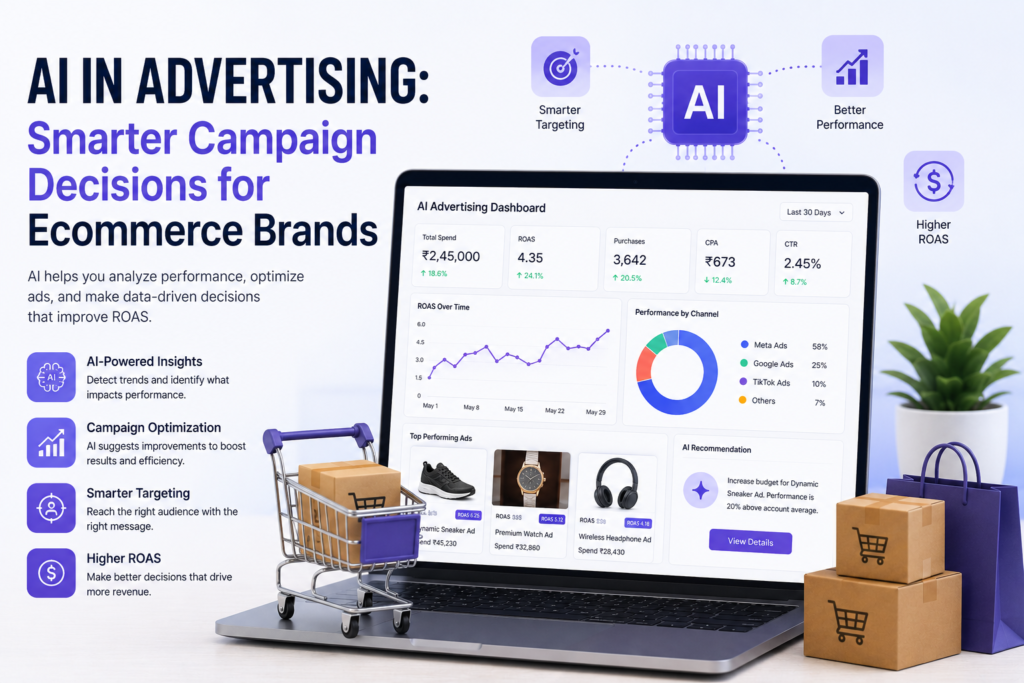
Smarter Advertising Starts Beyond Ad Creation
AI in advertising is changing how ecommerce teams approach campaign management. For years, marketers have used dashboards to track spend, clicks, conversions, CPA, and ROAS. Today, AI can go further by connecting these signals, identifying meaningful changes, and helping teams decide what deserves attention next.
That distinction matters.
Generating an ad is relatively easy. The harder problem starts after the campaign goes live. A drop in ROAS might be caused by creative fatigue, audience saturation, a weaker offer, product availability, landing-page issues, or tracking problems. Looking at one metric rarely explains the complete picture.
The real opportunity for AI for advertising is therefore not simply creating more ads. It is helping marketers interpret campaign data and make faster, more informed decisions while keeping human judgment at the center.
AI In Advertising Changes Campaign Management
Traditional campaign management often involves marketers checking several platforms, comparing date ranges, reviewing creatives, examining audience performance, and then deciding what needs investigation.
This process can become difficult as an ecommerce business grows.
A brand running campaigns across Meta and Google may also need to consider Shopify revenue, product margins, inventory, promotions, catalog performance, and creative history. The more products and campaigns a business manages, the harder it becomes to connect these signals manually.
AI in advertising can bring these different signals into a more structured decision-making process.
Instead of simply reporting that ROAS has declined, AI can help identify related changes, prioritize the most important issue, and suggest what the marketer should investigate next.
That turns advertising data into something more actionable.
Why Ecommerce Campaign Decisions Become Difficult
Ecommerce advertising is rarely influenced by one variable.
A campaign can have strong CTR but weak purchases. Another can have excellent conversion rates but limited budget. A product can generate strong revenue while receiving little advertising spend.
The Problem With Single-Metric Analysis
Suppose an ecommerce campaign experiences a 20% decline in ROAS.
A basic dashboard reports the decline. But it does not necessarily explain whether the problem is creative, audience, product, pricing, website conversion, inventory, or campaign structure.
This is where AI campaign optimization can become useful.
AI can compare multiple signals across different periods and sources to identify patterns that deserve closer attention. The output should be treated as an investigation rather than a guaranteed diagnosis.
For example, rising frequency combined with declining CTR and older creative assets may indicate creative fatigue. However, the marketer still needs to validate the audience, placement, offer, and comparison period before taking action.
AI Connects Signals Across Campaign Data
The biggest advantage of AI-driven campaign analysis is its ability to connect information that marketers might otherwise review separately.
Consider an ecommerce brand where Meta performance declines while Google performance and overall store conversion remain stable.
That pattern could suggest that the problem is concentrated within the Meta campaign rather than affecting the entire ecommerce operation.
Similarly, if CTR remains stable but store conversion falls, the problem may sit after the click. The team may need to investigate the product page, offer, checkout, inventory, or tracking instead of immediately changing the ad.
This is where AI ad optimization becomes more useful than simple automation.
The objective is not to react to every fluctuation. It is to identify relationships between signals that deserve human attention.
A Five-Step Framework For Better Decisions
A practical approach to AI in advertising can follow five stages:
Detect → Diagnose → Prioritise → Recommend → Human Review
Each stage answers a different question.
Detection identifies what has changed. Diagnosis examines which related signals may explain the change. Prioritization determines what deserves attention first. Recommendation defines the next investigation or test. Human review adds business context before any important decision is made.
This framework is particularly useful for growing ecommerce teams because not every campaign fluctuation deserves an immediate response.
A small daily movement may simply be normal campaign variation. A sustained decline across a high-spend campaign deserves much more attention.
Detection Helps Marketers Find Meaningful Changes
The first step is identifying changes that are material enough to investigate.
Relevant signals can include spend, spend velocity, ROAS, CPA, CAC, CTR, conversion rate, frequency, creative age, audience performance, product-level revenue, catalog spend, and product availability.
The advantage of AI is that these signals can be monitored continuously rather than requiring marketers to manually inspect every campaign.
However, effective monitoring should focus on meaningful changes rather than creating a constant stream of alerts.
For example, a campaign spending ₹5 lakh per month and suddenly falling below its recent ROAS baseline may deserve attention before a small campaign with a minor performance fluctuation.
This is where AI-supported monitoring can reduce unnecessary manual analysis and help marketers focus their time where it has the greatest business impact.
Diagnosis Goes Deeper Than Performance Reporting
Reporting tells marketers what happened.
Diagnosis attempts to determine what may be connected to the change.
Connecting Performance With Context
Imagine an ecommerce brand sees the following pattern: frequency increases, CTR declines, and two older creatives account for most of the deterioration.
The combination could indicate creative fatigue.
Now consider a different situation. CTR remains stable, but purchases decline while the product page conversion rate also falls.
That points the investigation in another direction.
The ad may still be attracting interest, but something after the click could be affecting purchases.
AI can make these connections easier to spot by comparing campaign, creative, audience, product, and store signals together.
Importantly, these patterns should remain hypotheses rather than treated as proven causes. Human validation is still necessary before making major campaign decisions.
Prioritization Prevents Marketing Teams From Reacting
A common challenge with large advertising accounts is having too much information.
Hundreds of ads can generate thousands of daily data points. Without prioritization, marketers can spend hours reviewing issues that have little commercial impact.
AI can help rank potential problems based on factors such as budget exposure, duration of the change, revenue impact, margin, related signals, inventory, and business priorities.
This changes the workflow.
Instead of asking, “What changed across the account?” marketers can ask, “Which change deserves my attention first?”
That is a much more useful question for decision-makers.
Recommendations Should Lead To Specific Tests
Once an issue is prioritized, AI can suggest what the marketing team should investigate or test.
A useful recommendation is specific.
“Improve the campaign” is too broad.
“Review the ad set because ROAS has fallen below its recent baseline while spend remains elevated” gives the marketer a clear starting point.
Similarly, if CTR is declining across older creatives while frequency is rising, the team can investigate creative fatigue before deciding whether to introduce new assets.
This makes AI ad optimization more practical because the system is not simply producing an automated answer. It is helping narrow down the next decision.
The recommendation should also show the evidence behind it. That allows marketers to understand why an issue was flagged rather than blindly accepting an AI-generated conclusion.
AI-Generated Ads Are Only One Piece
The popularity of AI-generated ads has made creative production one of the most visible applications of AI in marketing.
AI can help generate ad copy, images, concepts, and variations at a much faster pace.
That has clear operational value.
But production is only one part of campaign performance.
| AI-generated ads | AI-assisted campaign decisions |
|---|---|
| Creates creative variations | Reviews campaign signals |
| Speeds up production | Identifies performance changes |
| Produces copy and visuals | Connects campaign and ecommerce data |
| Supports campaign preparation | Helps prioritize issues |
| Expands testing capacity | Supports investigation and review |
The distinction is important because creating more variations does not automatically mean better performance.
A business also needs to understand which creatives are working, where performance is weakening, and what should be tested next.
This is where AI in advertising can move beyond content generation into campaign intelligence.
AI ROAS Optimization Needs Human Judgment
AI ROAS optimization should not be understood as a guarantee that AI will automatically increase return on ad spend.
ROAS is influenced by many variables, including creative quality, audience behaviour, offers, product economics, website experience, attribution, competition, and market conditions.
AI can help identify where ROAS is weakening and show which related metrics changed alongside it.
The marketer still needs to consider business context.
For example, a campaign with lower ROAS may still be strategically important if it is introducing new customers to a high-margin product. Likewise, a high-ROAS campaign may have limited scalability because of inventory or audience constraints.
The role of AI is to organize evidence and improve the quality of the investigation—not remove judgment from the process.
Human Review Keeps Campaign Decisions Responsible
The final stage should always involve human review.
Before changing budgets, pausing campaigns, launching tests, or changing strategy, marketers should validate the comparison period, promotion calendar, inventory situation, tracking setup, and relevant business context.
This approach prevents AI from turning a performance pattern into an assumed fact.
For ecommerce leaders, this balance is important.
AI can reduce repetitive monitoring and bring relevant signals together, while experienced marketers remain responsible for strategy, approvals, risk management, and commercial decisions.
The best model is not AI replacing the performance marketer.
It is AI helping the performance marketer spend less time searching through dashboards and more time making informed decisions.
Turning Advertising Data Into Business Decisions
The long-term value of AI for advertising comes from connecting campaign performance with the wider ecommerce operation.
A campaign does not exist independently of the product it promotes.
Inventory, margins, pricing, product availability, catalog quality, customer behaviour, promotions, and store conversion can all affect advertising performance.
When these signals are reviewed together, marketers can make better decisions about where to spend, what to test, and what requires investigation.
For growing ecommerce businesses, that can create a meaningful operational advantage.
Instead of producing more reports, teams can focus on producing clearer decisions.
Final Thoughts
AI in advertising is moving beyond the idea of automatically generating more creative assets. Its more valuable role is helping ecommerce teams understand campaign performance, connect related signals, prioritize meaningful issues, and determine what deserves attention next.
AI campaign optimization, AI ad optimization, and AI ROAS optimization can make performance reviews more structured, but they work best when marketers remain in control.
The future of ecommerce advertising will not simply belong to brands that create the most AI ads. It will increasingly favor brands that can turn large volumes of campaign data into faster, clearer, and more commercially informed decisions.
Book a demo today to see how AI-powered campaign intelligence can help your ecommerce team monitor performance, identify issues, and make smarter advertising decisions.
FAQs
1. What is AI in advertising?
AI in advertising uses artificial intelligence to support areas such as ad creation, campaign monitoring, performance analysis, optimization, and decision support. It can connect campaign, creative, audience, product, and ecommerce signals to help marketers identify what deserves attention. Platforms like ShopOS help businesses make faster, data-driven marketing decisions.
2. How does AI ad optimization work?
AI ad optimization can monitor campaign metrics, identify meaningful changes, compare related signals, prioritize potential issues, and suggest areas for investigation or testing. Human marketers should validate the evidence before making significant changes.
3. Are AI-generated ads enough to improve campaign performance?
Not necessarily. AI-generated ads can increase creative production speed, but performance also depends on audience quality, offers, products, landing pages, pricing, inventory, and campaign strategy. Creative generation is only one part of campaign optimization.
4. Can AI automatically improve ROAS?
No system can guarantee improved ROAS. AI ROAS optimization can help identify where ROAS is weakening and highlight related performance signals, but marketers still need to evaluate business context before deciding what action to take.
5. Can AI replace ecommerce performance marketers?
AI can reduce manual monitoring and organize large amounts of campaign data, but it should not replace human judgment. Marketers remain responsible for strategy, validation, budget decisions, business context, and final approvals.