


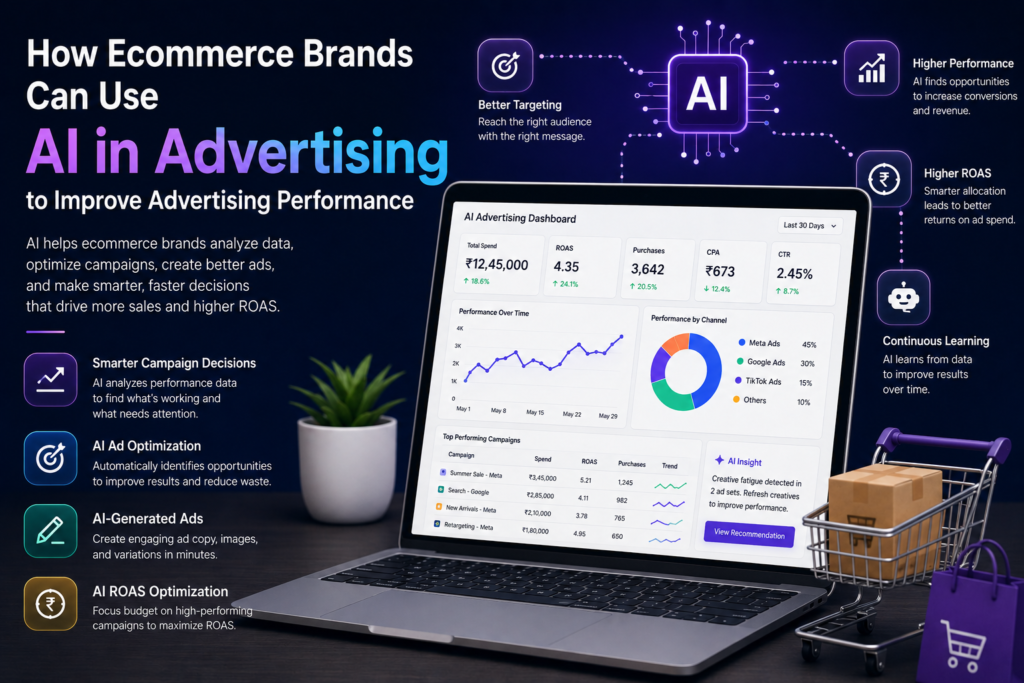
Smarter Advertising Starts With Better Campaign Decisions
AI in advertising is changing how ecommerce brands plan, launch, monitor, and improve their campaigns. Advertising teams no longer have to rely entirely on manually reviewing dashboards, comparing spreadsheets, or waiting until the end of a campaign to understand what worked.
The bigger opportunity is not simply creating ads faster. It is using AI to connect campaign data, identify performance patterns, understand what may be affecting results, and help marketers decide what to do next.
For an ecommerce brand managing multiple products, audiences, platforms, and creatives, this can make a significant difference. A campaign may generate thousands of impressions and clicks while producing fewer purchases than expected. Another campaign may have strong ROAS but limited room to scale.
AI for advertising can help marketers examine these situations more efficiently while keeping strategic decisions under human control.
The result is a shift from simply measuring advertising performance to actively learning from it.
Why AI In Advertising Matters For Ecommerce Growth
Ecommerce advertising has become increasingly complex. Brands may run campaigns across Meta, Google, TikTok, marketplaces, and other channels while simultaneously managing product feeds, promotions, inventory, landing pages, and customer data.
Traditional reporting can show what happened, but it does not always explain why.
A sudden ROAS decline, for example, could come from creative fatigue, rising competition, audience saturation, a weaker offer, lower website conversion, or changes in product availability.
This is where AI in advertising becomes valuable.
AI can evaluate multiple signals together instead of forcing marketers to inspect each metric separately. It can highlight unusual changes, identify relationships between metrics, and help teams determine which issues deserve further investigation.
That makes campaign management more proactive.
Turning Advertising Data Into Actionable Insights
Modern ecommerce campaigns generate enormous amounts of data. Click-through rates, impressions, spend, purchases, CPA, ROAS, frequency, conversion rates, creative performance, and product revenue all tell part of the story.
The challenge is connecting them.
Imagine an ecommerce brand notices that ROAS has fallen by 18%. A basic report identifies the decline, but the marketing team still has to investigate.
An AI system can help compare the change against other signals. If frequency has increased, CTR has fallen, and the majority of spend is going toward older creatives, creative fatigue could be one possible explanation.
If CTR remains stable but website conversion has declined, the problem may be further down the customer journey.
This is where AI campaign optimization becomes useful. Rather than automatically making changes, AI can help marketers narrow down the areas that need attention.
AI Helps Marketers Identify Problems Earlier
One of the strongest applications of AI in advertising is continuous performance monitoring.
Human teams cannot realistically examine every campaign, ad set, product, and creative every hour. As an account grows, small performance changes can easily go unnoticed.
AI can monitor predefined performance signals and identify changes that may be meaningful.
For example, an ecommerce brand might notice that:
- Spend is increasing while conversions remain flat.
- CTR is declining as ad frequency rises.
- A previously strong creative is losing efficiency.
- CPA is increasing for a high-value product.
- One audience is generating stronger returns than similar segments.
These signals do not automatically prove that something is wrong. Instead, they provide marketers with a starting point for investigation.
Why Early Detection Matters
Waiting several days to discover that an important campaign is underperforming can become expensive.
Early detection gives marketers an opportunity to review the issue before it significantly affects revenue or budget efficiency.
This is especially important for brands operating during seasonal periods, product launches, promotional events, and high-demand shopping periods.
AI Ad Optimization Goes Beyond Automated Rules
Traditional advertising platforms already provide automated bidding, targeting, and budget features.
However, AI ad optimization can offer a broader analytical layer by helping marketers understand why performance may be changing.
For example, a rule might automatically increase a campaign budget when ROAS crosses a certain threshold.
That can be useful, but it does not necessarily consider product margin, inventory availability, promotional strategy, or whether the campaign has enough scale to support additional spending.
AI-assisted optimization can help marketers consider a wider set of signals.
A high ROAS campaign may not always deserve more budget. If the product has limited inventory, scaling the campaign aggressively could create operational problems.
This is why optimization should connect advertising performance with broader business context.
AI-Generated Ads Improve Creative Production
Creative production is another area where AI-generated ads are changing ecommerce advertising.
Instead of creating every variation manually, brands can use AI to develop different headlines, visual concepts, product angles, messaging variations, and formats.
This can significantly reduce production time.
A fashion ecommerce brand, for example, may want separate creative concepts for customers interested in affordability, premium quality, seasonal trends, or specific product benefits.
AI can help generate variations for these audiences much faster than a completely manual workflow.
However, producing more ads does not automatically improve performance.
The important question is which creative ideas actually resonate with the intended audience.
That brings creative generation back into the broader AI for advertising workflow.
Creative Performance Becomes Easier To Understand
Creating hundreds of creative variations can create another challenge: knowing what actually worked.
AI can help analyze creative performance alongside metrics such as CTR, conversions, spend, CPA, and ROAS.
Instead of simply identifying the highest-performing ad, marketers can look for patterns.
Perhaps product-focused images perform better than lifestyle images for one audience. Maybe short-form videos generate stronger engagement among new customers. Another segment might respond better to promotional messaging.
These insights can influence future creative production.
This creates a useful cycle:
Create → Test → Measure → Learn → Refine
Over time, the brand develops a better understanding of what messaging and creative approaches work for different audiences.
AI ROAS Optimization Needs More Than One Metric
AI ROAS optimization should not mean chasing the highest ROAS number at all costs.
ROAS is important, but it is only one part of ecommerce advertising performance.
A campaign with a 6x ROAS may have limited spending potential, while another campaign with a 3x ROAS may be generating significantly more incremental revenue at scale.
Business leaders also need to consider margins, customer acquisition costs, repeat purchases, average order value, inventory, and product strategy.
AI can help bring these signals together, but marketers still need to determine what success means for the business.
The Risk Of Optimizing Too Narrowly
If an AI system focuses only on immediate ROAS, it could favor campaigns that capture existing demand while overlooking campaigns designed to introduce new products or acquire new customers.
The best approach is to use AI to support broader commercial objectives rather than optimizing a single metric in isolation.
Connecting AI Advertising With Ecommerce Operations
Advertising performance does not happen in isolation.
A campaign can perform differently because a product is out of stock, pricing has changed, a promotion has ended, or a landing page has been updated.
This is why the future of AI in advertising is increasingly connected to ecommerce operations.
Imagine an AI system identifies that a product campaign is performing exceptionally well. Before recommending increased spending, the marketing team should also know whether enough inventory is available.
Similarly, if advertising clicks remain stable but purchases fall, the team may need to investigate the website experience instead of changing the ads.
Connecting advertising data with ecommerce context helps marketers make more informed decisions.
Human Oversight Still Matters In AI Advertising
AI can process data quickly, but it does not automatically understand every business decision.
A performance marketer may know that a campaign is intentionally running at a lower ROAS because it supports a product launch. A merchandising team may know that a particular product should not be scaled because inventory is limited.
These details matter.
For this reason, effective AI campaign optimization should support marketers rather than operate as a completely independent decision-maker.
AI can identify patterns, surface opportunities, and recommend areas to investigate.
The marketing team can then validate the information and decide whether action is appropriate.
This combination provides speed without removing accountability.
Building A Practical AI Advertising Workflow
Ecommerce brands do not need to transform their entire advertising operation overnight.
A practical starting point is to identify repetitive tasks that consume significant marketing time.
Campaign monitoring is one example. Creative performance analysis is another. Reporting, anomaly detection, audience comparisons, and performance summaries can also benefit from AI.
Once these processes are established, teams can gradually expand AI usage into areas such as creative development, testing recommendations, budget analysis, and campaign planning.
The goal should not be to use AI everywhere.
The goal should be to use it where it improves the quality or speed of decisions.
Measuring The Business Impact Of AI
The success of AI in advertising should ultimately be measured by business outcomes rather than the number of AI features being used.
Ecommerce leaders can evaluate whether AI is helping the team reduce manual analysis, identify performance problems earlier, improve testing efficiency, increase creative production speed, or make better budget decisions.
The financial impact matters too.
If marketers can identify underperforming campaigns sooner, discover winning creative patterns faster, and allocate budget more effectively, AI can contribute to stronger advertising efficiency.
But measurement should remain realistic. Not every improvement will come directly from AI, and attribution can be complicated.
The strongest approach is to establish clear benchmarks and compare performance over time.
Final Thoughts
AI in advertising is becoming an important part of how ecommerce brands manage campaign performance. Its value goes beyond creating AI ads or generating creative variations.
The bigger opportunity lies in using AI for advertising to connect campaign signals, identify meaningful changes, support AI ad optimization, improve creative testing, and make AI ROAS optimization more informed.
For ecommerce brands, the objective should not be to replace marketers with automation. It should be to give marketing teams better information, faster analysis, and more time to focus on strategic decisions.
As advertising becomes more data-intensive, brands that combine human judgment with intelligent technology will be better positioned to test, learn, and scale efficiently.
Book a demo today to see how AI-powered campaign intelligence can help your ecommerce team monitor performance, identify opportunities, and make smarter advertising decisions.
FAQs
1. How can AI improve ecommerce advertising performance?
AI can help ecommerce brands monitor campaign data, identify performance changes, analyze creative results, discover patterns, and prioritize areas that need attention. It can make campaign analysis faster while leaving final decisions with marketers. Platforms like ShopOS help businesses make faster, data-driven marketing decisions.
2. What is AI ad optimization?
AI ad optimization uses AI to analyze advertising signals and support decisions around campaigns, audiences, creatives, budgets, and performance. It can help identify opportunities and issues that may otherwise require extensive manual analysis.
3. Can AI-generated ads improve ecommerce campaigns?
AI-generated ads can help brands produce creative variations faster and test different messaging or visual concepts. However, creative volume alone does not guarantee better performance. Results still depend on audience, offer, product, positioning, and campaign strategy.
4. How does AI ROAS optimization work?
AI ROAS optimization can analyze ROAS alongside metrics such as spend, conversions, CPA, CTR, creative performance, and product data. This can help marketers understand changes in efficiency and determine what should be investigated before making budget decisions.
5. Will AI replace ecommerce advertising teams?
AI is more likely to change how advertising teams work than completely replace them. It can reduce repetitive analysis and monitoring, while marketers continue to provide business context, strategy, creative judgment, and final approval.